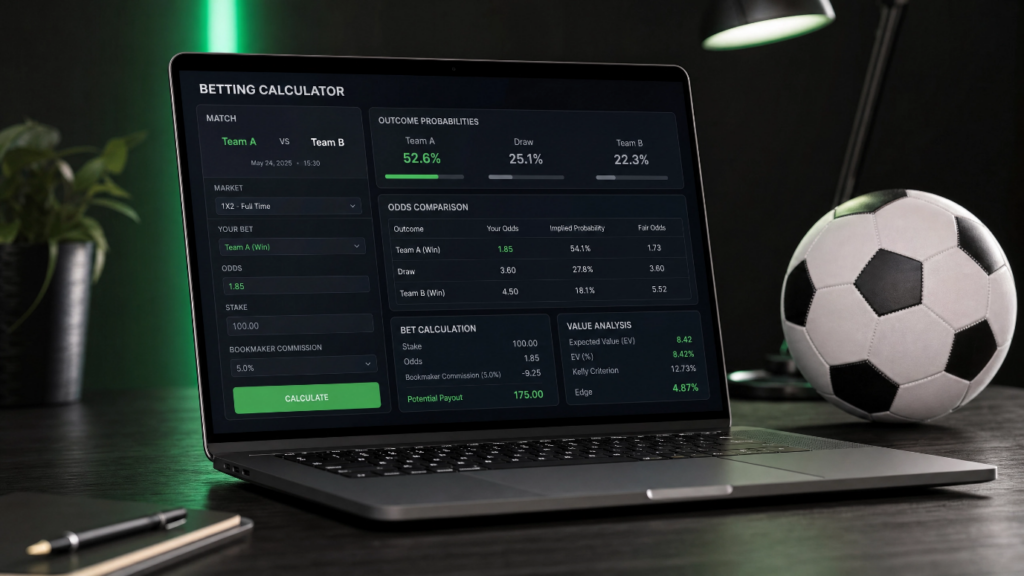
The difference between a recreational bettor and a consistently profitable one rarely comes down to luck. More often, it comes down to preparation — and specifically, to the tools used before a single wager is placed.
Over the past few years, a quiet but significant shift has taken place in how serious sports bettors approach their craft. Where gut instinct and loyalty to a favourite team once drove most decisions, data-driven thinking and calculation tools are now at the centre of the process. Understanding this shift is key to understanding why some bettors consistently outperform the market while others do not.
The Problem with Betting Without Numbers
Most recreational bettors operate on a simple mental model: they pick a team, check the odds, and decide whether the payout feels worth the risk. The problem is that “feeling” is not a reliable system. Bookmakers spend enormous resources setting lines that exploit exactly this kind of intuitive thinking.
When you place a bet without calculating the implied probability behind the odds, you are essentially operating blind. A line of 2.50 on a football match implies a 40% probability of that outcome occurring. If your own assessment of the match suggests the true probability is closer to 50%, you have found value. If your assessment is closer to 30%, you are walking into a losing bet — regardless of whether the team wins on the day.
This is the fundamental problem that calculation tools solve. They translate odds into probabilities, expected value into concrete numbers, and potential payouts into clear, comparable figures.
Why Calculation Tools Have Become Essential
The rise of online betting has made access to odds easier than ever, but it has also made the market more efficient. Bookmakers adjust lines faster, margins are tighter on major markets, and the casual bettor is increasingly at a disadvantage without proper tools.
Sports betting calculator tools bridge this gap. Whether you are working out the return on an accumulator, comparing decimal and fractional odds across different platforms, or calculating the implied probability of a market, a good calculator removes the mental arithmetic and lets you focus on the decision itself.
The practical impact is significant. A bettor who consistently identifies lines where the implied probability is lower than their own assessed probability — even by a small margin — will outperform the market over time. Without a calculator, this kind of edge identification is nearly impossible to do accurately at scale.
Applying This to Real Betting Decisions
Consider a practical example. You are looking at a Premier League match and the odds on the draw are listed at 3.40 across most bookmakers. That implies a probability of roughly 29.4%. Your analysis of the teams’ recent form, head-to-head record, and tactical setup suggests the true probability of a draw is closer to 35%. That gap — 5.6 percentage points — represents genuine value.
Without running the numbers, you would never know that gap exists. With a calculator, it takes thirty seconds to confirm.
This same logic applies to more complex bet types: system bets, each-way wagers, and multi-leg accumulators all benefit from proper calculation before commitment. The compounding effect of small edges across many bets is what separates disciplined bettors from the rest.
Choosing the Right Platform Matters Too
Calculation tools are only one part of the equation. The platform you bet on — its odds competitiveness, available markets, payout speed, and bonus structures — has an equally significant impact on long-term results.
This is why experienced bettors spend as much time evaluating bookmakers as they do evaluating individual matches. Resources like BetReviews247 provide the kind of structured, detailed platform analysis that helps bettors make informed decisions about where to place their money, not just how much to stake.
The combination of sharp calculation habits and careful platform selection is the foundation of sustainable, intelligent betting.
Final Thought
Betting will always carry risk. No tool eliminates that. But the bettors who approach the activity with discipline, data, and the right resources consistently make better decisions than those who rely on instinct alone. In a market designed to exploit the underprepared, calculation is not optional — it is the baseline.
Please gamble responsibly. This article is intended for informational purposes only and does not constitute financial advice. Only bet what you can afford to lose.